Enlisted explained: how the free-to-play WWII squad shooter actually works
This page contains partner links, labelled “Partner link” wherever they appear. If you use one and then sign up or spend money, the advertiser may pay CRANBERG COMPANY s.r.o. a commission. You are never charged more because of it, and you are free to go to the game’s official site directly instead.
The commission does not buy a verdict. Nothing below was written to order, the drawbacks section is not decorative, and we have corrected several claims that an earlier version of this page made and could not support.
Trademarks: Enlisted is a trademark of its respective owner. This site is independent and is not affiliated with, endorsed by or sponsored by Darkflow Software, Gaijin Entertainment or any other rights holder named here.
Most shooters hand you one soldier. Enlisted hands you a squad, lets you drive one of its members yourself, and quietly runs the rest. That single decision changes how a match feels, what a good player is good at, and why the game is harder to describe than its screenshots suggest. This guide explains the mechanics as they stand, says where our information could be out of date, and flags the parts you should check against the developer’s own pages.
What Enlisted is
Enlisted is a free-to-play squad-based shooter set in the Second World War. It is developed by Darkflow Software and published by Gaijin Entertainment, the studio behind War Thunder, and it is built on Gaijin’s in-house Dagor engine technology. The game entered open beta in 2021 and has been updated continuously since; it is free to download, and there is no purchase required to start playing.
The setting matters, because it constrains everything else. There are no helicopters, no drones, no red-dot optics and no modern ordnance. The weapons are period bolt-action rifles, submachine guns, early self-loading rifles, machine guns and grenades; the vehicles are period tanks and propeller-driven aircraft. If you came looking for a contemporary military shooter, this is not one.
Enlisted originally organised its content into separate campaigns, each tied to a theatre of the war — Moscow, Normandy, Tunisia, Berlin, Stalingrad and the Pacific — with progress in one campaign counting for nothing in another. In 2024 the developer released a large restructuring update, presented as Enlisted: Reforged, which replaced that arrangement with a single progression line per nation. Older guides and videos that talk you through “choosing a campaign” are describing the system this update replaced. If you find advice that does not match what you see on screen, that is usually why.
The squad system, which is the whole point
This is the mechanic worth understanding before anything else, because every other design decision in the game follows from it.
When you deploy, you do not spawn as one soldier. You spawn as a squad. You directly control one member of it; the others are controlled by the game and follow you, taking cover and firing on their own. You can point them at a position, tell them to hold, and switch which of them you are driving. When the soldier you are controlling is killed, you do not go to a respawn screen — you take over the next member of the same squad who is still alive, roughly where they happen to be standing. Only when the whole squad is gone do you go back to the deployment screen and pick another squad from the ones you brought into the battle.
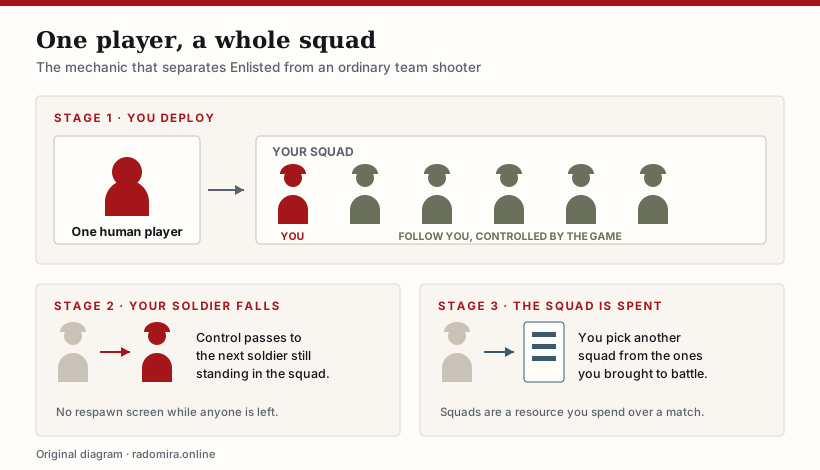
Two consequences follow, and they are the reason players either love the game or bounce off it. First, a squad is a resource you spend: reckless play burns through your squads and eventually leaves you with nothing good left to deploy. Second, the number of soldiers on the field is far higher than the number of human players, which is how relatively small player counts produce battles that look and sound enormous.
Team sizes and squad sizes in Enlisted vary by mode and squad type, and both have been changed by updates. We have seen a number of guides state a precise player count as though it were fixed; an earlier version of this page did the same, and it was wrong. The honest answer is that a match is built around a modest number of human players per side, each commanding a squad, and that the mode description inside the game is the only figure worth trusting on the day you read it.
Partner link. If you sign up or spend money after using it, CRANBERG COMPANY s.r.o. may receive a commission from the advertiser. It costs you nothing extra, and you can go to the game’s own official site directly instead.
Squad roles and what each one is for
You do not pick a class the way you would in a typical shooter. You pick which squads to bring into the battle, and each squad type is built around a job. Bringing four squads that all do the same thing is the most common beginner mistake.
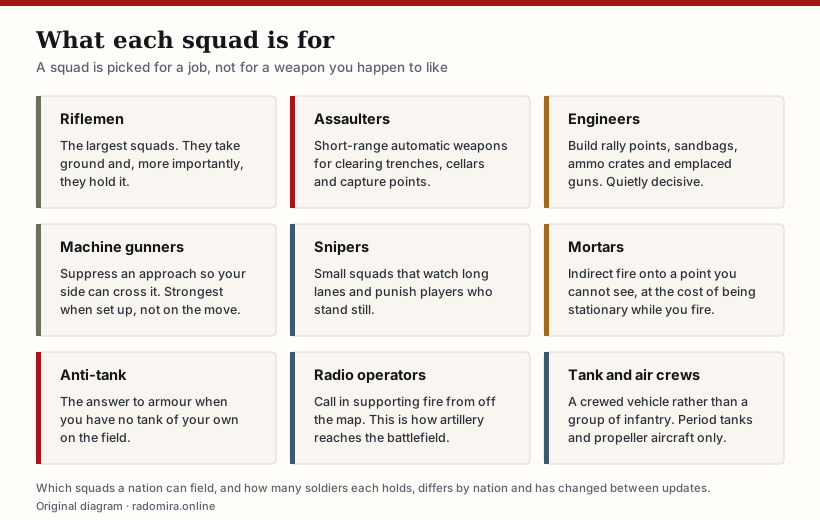
A few of these deserve a sentence more than the diagram allows.
Engineers are the role new players most often ignore and experienced players most often prioritise. They build structures from a build menu — sandbags, barbed wire, ammunition boxes, emplaced weapons and, above all, rally points, which let your squads enter the map near the fighting instead of walking to it. A well-placed rally point can decide a match more reliably than any weapon in the game.
Radio operators are how artillery reaches the battlefield. You do not crew a gun; you mark a position and fire arrives from off the map. This is worth stating because guides sometimes describe Enlisted as having a playable artillery class, which is not how it works.
Mortar squads are the closest thing to hands-on indirect fire: you set up, you fire on an area you cannot see, and you are stationary and vulnerable while you do it.
Tanks and aircraft
Vehicles are not a separate mode bolted on; they are squads like any other. A tank squad is a tank and its crew, and an aircraft squad is a period fighter, attacker or bomber. You bring them into the same battle as your infantry and switch to them when the situation calls for it.
Both are limited on purpose. There is a cap on how many vehicles a side can have in play at once, so a match does not collapse into an armour parade, and infantry have real answers to armour: anti-tank squads, explosives and emplaced guns. The practical effect is that a tank is strong in the open and distinctly nervous in a town, which is roughly how it should be.
Aircraft are the most specialised part of the game. Flying well takes its own set of skills, the airframes handle like the era they come from, and a bomber run that misses is simply a squad you have spent for nothing. If you have no interest in flying, you can play hundreds of hours without ever taking off.
How a match actually plays out
The standard structure is a sequence of objectives that fall one after another, with the front line stepping forward each time one is taken. One side attacks, the other defends, and the match ends when the attackers run out of objectives to take or the defenders run out of time or reinforcements.
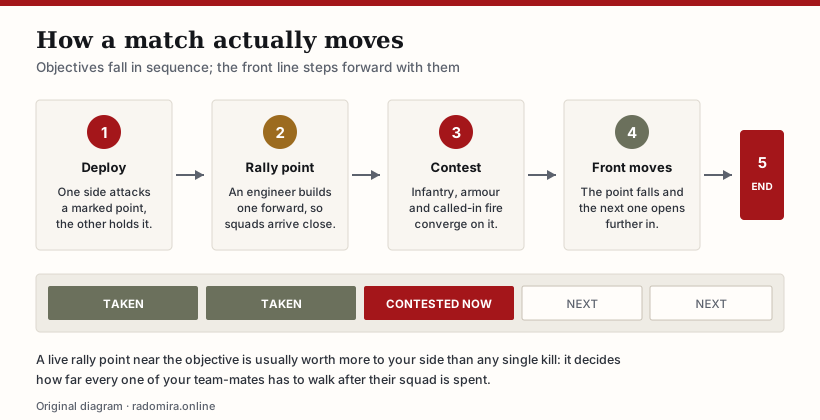
What this means in practice is that Enlisted rewards logistics more than reflexes. The team that keeps a forward rally point alive arrives at the objective in seconds; the team that loses its rally points spends the match walking. Very good players in this game are often not the ones with the best aim — they are the ones who noticed where the rally point was and went to protect it.
Partner link. If you sign up or spend money after using it, CRANBERG COMPANY s.r.o. may receive a commission from the advertiser. It costs you nothing extra, and you can go to the game’s own official site directly instead.
Progression: what unlocks and what it costs you
You choose a nation, and that nation has its own pool of squads, soldiers, weapons and vehicles. Playing matches earns experience and in-game currency, which unlock further squads and equipment along a tiered research path.
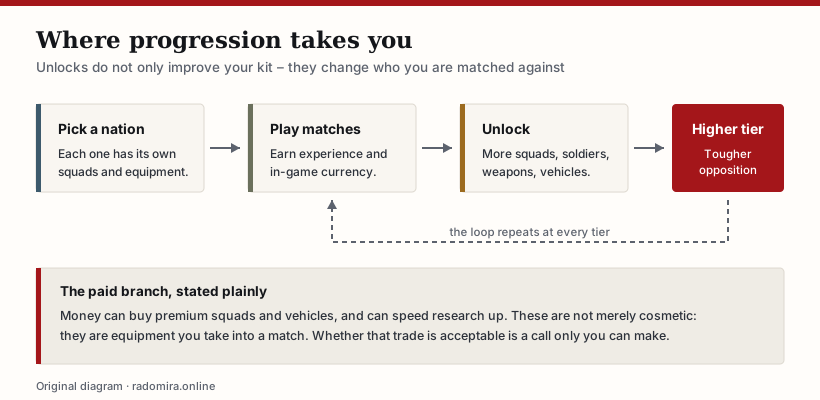
The point the diagram makes is worth saying in words too. In many games, unlocking better equipment simply makes you stronger. In Enlisted, moving up a tier also moves you into battles against better-equipped opponents. A player who rushes up the research path with a thin roster of squads can end up worse off than one who stayed lower and built a balanced set. If your matches suddenly feel much harder, this is the usual explanation.
What money actually buys
Enlisted is free to download and free to play, and it is entirely possible to play it for a long time without spending anything. What money buys is worth stating precisely, because this is exactly the sort of claim that guides get wrong in the game’s favour.
Real money buys the game’s premium currency, and that currency can be spent on premium squads and premium vehicles, on a battle pass, and on boosts that make research go faster. Premium squads and vehicles are not cosmetic: they are equipment you take into a match, often available without going through the research that would otherwise gate it.
Whether that amounts to “pay to win” is a judgement, and an honest guide should say so rather than decide it for you. The defensible version of the claim is this: paid content in Enlisted is functional rather than decorative, it is not obviously more powerful than what research gives you at the same tier, and it definitely shortens the time it takes to get there. An earlier version of this page asserted that the game “does not rely on pay-to-win mechanics” and that paid items were cosmetic only. Both statements were wrong and we have removed them.
Where it runs
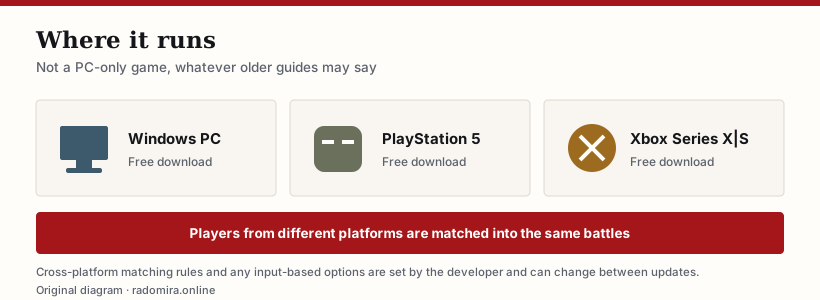
Enlisted runs on Windows PC, PlayStation 5 and Xbox Series X|S, and players from different platforms are matched into the same battles. On PC it is available both through Gaijin’s own launcher and through Steam.
We are deliberately not printing a specification table here. Published minimum and recommended requirements for live-service games are revised as the game is updated, and a figure copied from a third-party page is exactly the kind of thing that goes stale without anyone noticing. Read them on the game’s own store page for your platform, on the day you install.
The same goes for the age rating. It is shown on the store listing for your platform and country, and that listing is the one that counts.
Where Enlisted sits in the genre
Enlisted is usually compared with two neighbours: large-scale arcade war shooters on one side, and slower, drill-heavy Second World War simulations on the other. It does not sit neatly in either camp. Rather than make claims about other studios’ games that we cannot check for you, here is what Enlisted itself does, and what each choice costs.
| Design choice | What Enlisted does | What it costs you |
|---|---|---|
| Unit of play | You command a squad; one member is under your direct control, the rest are run by the game. | Your AI squadmates are competent but not clever. They will sometimes do something daft at the worst moment. |
| Death | You take over the next soldier in the squad rather than waiting on a respawn timer. | Less downtime, but also less pressure to play carefully than a one-life design would give you. |
| Scale | A modest number of human players per side produces a very large number of soldiers on the map. | Battles feel crowded, which is the point, but individual skill is diluted by everything else happening. |
| Logistics | Engineer-built rally points determine how quickly your side reaches the fight. | A team that ignores this loses to one that does not, regardless of aim. |
| Vehicles | Tanks and aircraft are squads, capped in number, with real infantry counterplay. | Learning to fly is a separate hobby. Many players never bother, and lose nothing by it. |
| Setting | Strictly Second World War equipment, no modern kit. | If you want contemporary weapons or gadgets, this is the wrong game entirely. |
| Price | Free to download; premium squads, vehicles, a battle pass and research boosts are sold. | Paid content is functional, not cosmetic. How much that bothers you is your call. |
Getting started without wasting your first evening
- Install it from an official source. On PC that means Gaijin’s own launcher or Steam; on console, your platform’s own store. Enlisted is free, so any page asking you to pay for the base game is not one to trust.
- Pick one nation and stay with it. Progress belongs to the nation you are playing. Spreading yourself across several at once is the fastest way to feel permanently under-equipped.
- Bring an engineer squad from the very beginning. Building the first forward rally point of a match is, for a new player, the single highest-value thing you can do, and it does not require you to win a gunfight.
- Mix your squads. Something to hold ground, something to clear a building, something for armour, and the engineer. Four squads that all do the same job will leave you helpless the moment the situation changes.
- Resist climbing the research tree quickly. Higher tiers mean harder opposition. Build a broad roster at a tier you are comfortable at before you push upward.
- Give it three or four matches before judging it. The squad mechanic does not make sense until you have lost a soldier mid-firefight and carried on as the next one.
Partner link. If you sign up or spend money after using it, CRANBERG COMPANY s.r.o. may receive a commission from the advertiser. It costs you nothing extra, and you can go to the game’s own official site directly instead.
Honest drawbacks
A page that only lists strengths is an advertisement, whatever it calls itself. These are the things we would want to know before installing.
- The AI is the ceiling and the floor. Squadmates hold their own most of the time and let you down some of the time. If the idea of losing a fight because a computer-controlled soldier stood in a doorway irritates you, it will keep irritating you.
- Paid content is functional. Premium squads and vehicles are equipment, not hats. Reasonable people disagree about how much that matters; nobody should pretend it is not the case.
- The learning curve is front-loaded and badly signposted. Nothing in the early game tells you clearly that engineers and rally points are the centre of gravity.
- Tier pressure is real. Advancing can make your matches harder rather than easier, which is counter-intuitive and catches people out.
- Much of the advice online is out of date. The 2024 restructuring invalidated a large amount of the written and video guidance that is still the top result for many searches.
- It is a live-service game. Balance, content and monetisation are all subject to change by the developer, and nothing on this page is a promise about what the game will look like next year.
Questions we get asked
Is Enlisted really free?
Yes. The game is free to download and free to play on all its platforms. There is no purchase required to install it or to play matches. Money is spent on premium squads and vehicles, a battle pass and research boosts — see what money actually buys.
Is it pay to win?
That depends on your definition, and we are not going to settle it for you. What is verifiable: paid content includes functional equipment rather than only cosmetics, and it shortens the research grind. What we will not claim: that paid squads are decisively stronger than researched ones at the same tier, because that is a balance judgement that changes with every patch.
Is it a modern warfare game?
No. Enlisted is set in the Second World War. There are no helicopters, drones or modern weapons. If a guide tells you otherwise — and an earlier version of this page did — it is wrong.
Can I play it on a console?
Yes. It is available on PlayStation 5 and Xbox Series X|S as well as Windows PC, and players on different platforms are matched into the same battles.
Is it the same thing as War Thunder?
No, although the two are related. War Thunder is published by the same company, Gaijin Entertainment, and Enlisted uses the same underlying engine technology. Enlisted is an infantry-centred squad shooter; War Thunder is a vehicle combat game. Progress in one does not carry over to the other.
What happened to the campaigns people keep mentioning?
Enlisted used to separate its content into campaigns tied to individual theatres, with separate progression in each. A major 2024 restructuring replaced that with one progression line per nation. Guides that talk you through choosing a campaign predate that change.
Do I need friends to play it?
No. Because you always bring your own squad of soldiers, solo play is viable in a way it is not in games that depend on human squadmates. Playing with people you know is still better, mostly because rally points and vehicles reward coordination.
How this page is funded
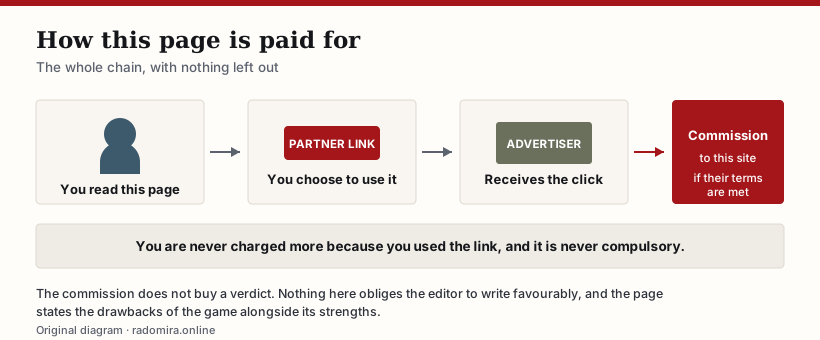
CRANBERG COMPANY s.r.o. pays for this site through partner links. If you use one of the links on this page and then create an account or spend money, the advertiser may pay us a commission. You pay no more than you otherwise would, and you are never obliged to use the link: the game’s own site and your platform’s store are both a search away.
What that arrangement does not buy is the content of this page. The advertiser did not see it before publication, has no right of review over it, and cannot have a drawback removed. Our editorial policy sets out what we will and will not do, including the practices — invented reader testimonials, made-up star ratings, artificial countdowns and guaranteed-outcome claims — that we refuse outright.
Sources, and what we corrected
Everything above was written against the developer’s and publisher’s own published material and the game’s store listings. Where we were not able to verify a specific figure, we have said so in the text rather than printing a number that looks authoritative.
- Enlisted official site and news — enlisted.net (not a partner link)
- Gaijin Entertainment, publisher — gaijin.net (not a partner link)
- Darkflow Software, developer — studio pages and update notes (not a partner link)
- Platform store listings for Windows PC, PlayStation 5 and Xbox Series X|S, for availability, pricing model and age rating
- In-game mode descriptions, for team composition and squad sizes on the day you play
Enlisted is a live-service game and its details change with each update. If anything on this page conflicts with information published by Darkflow Software, Gaijin Entertainment or your platform holder, their information prevails. If you find something here that is out of date or wrong, tell us at info@radomira.online and we will correct it and say that we did — our corrections procedure is described in the editorial policy.
Claims we removed from the previous version of this page
- That the game simulates “modern warfare”. It is a Second World War game.
- That players can pilot helicopters. There are no helicopters in it.
- That artillery is a playable class. Artillery is called in by radio operator squads; mortars are a separate squad type.
- A specific maximum player count per match, which we could not verify and which varies by mode.
- That the game is PC-exclusive. It is also on PlayStation 5 and Xbox Series X|S.
- That its monetisation is cosmetic-only and free of pay-to-win mechanics. Paid squads and vehicles are functional equipment.
- A headline calling it “the best military shooter for PC”, which is an opinion dressed as a fact.
- A comparison table asserting that unnamed competing games have smaller maps and pay-to-win mechanics, which we cannot substantiate.
- An “18+” badge, which described neither the game nor this site accurately.
Partner link. If you sign up or spend money after using it, CRANBERG COMPANY s.r.o. may receive a commission from the advertiser. It costs you nothing extra, and you can go to the game’s own official site directly instead.
Guide written and edited by Linda Davis, director of publication and responsible editor, for CRANBERG COMPANY s.r.o.. Published 23 September 2026. Corrections: info@radomira.online.